
Not Every Sleep Test is the Same. And Not Every Patient Needs the Same Test.
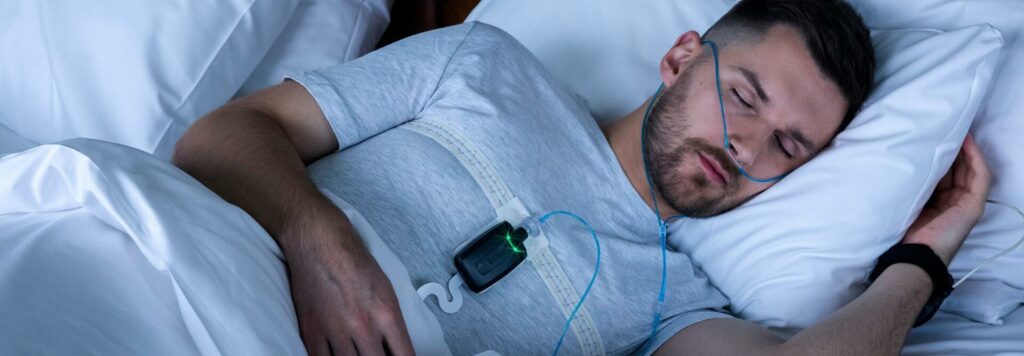
If you have been struggling with loud snoring, daytime fatigue, or witnessed breathing pauses during sleep, you have probably come across the option of a home sleep test. It sounds ideal. No hospital visit. No wires attached to your head. Just a small device you take home, sleep with it, and return it the next morning.
Home Sleep Apnea Testing was developed with a very specific goal in mind: to help patients with straightforward but severe sleep apnea get diagnosed quickly and start treatment without delay. For that group, it is a genuine breakthrough.
But here is what often gets missed in the conversation. A home sleep test is simply not designed or equipped to evaluate complex patients. It cannot tell you if your breathing control system is unstable, a condition called high loop gain. It cannot detect if you wake up too easily with the slightest airway narrowing, known as a low arousal threshold. It cannot identify the various biological patterns, or endotypes, that may require completely different treatment approaches.
A home test can confirm that your airway collapses. It cannot tell you why it keeps collapsing, or what else might be happening beneath the surface.
What a Home Sleep Test Can and Cannot Do
A home sleep apnea test typically records:
- Your breathing rate and airflow
- Oxygen levels in your blood
- Heart rate
- Body position
- Snoring intensity
It is lightweight, convenient, and increasingly affordable. But it does not record brain activity. It cannot tell if you were actually asleep when the events occurred. It cannot map your sleep stages. It cannot detect limb movements or distinguish between obstructive and central events with complete certainty.
This is not a flaw in the device. It is simply what it was built for: screening and diagnosis of uncomplicated, moderate to severe obstructive sleep apnea in otherwise healthy individuals.
According to international guidelines and our three decades of experience, the ideal candidate for a home sleep test is an adult with:
- Loud and frequent snoring
- Witnessed apneas by a bed partner
- Daytime sleepiness
- No significant heart failure
- No advanced lung disease such as severe COPD
- No suspected neurological sleep disorders
When a Home Test is Not Enough
In-lab Polysomnography remains the gold standard for everyone who does not fit this profile. You should be tested in a sleep lab if:
- Your symptoms suggest sleep apnea but your home test came back negative or inconclusive
- You have heart failure, atrial fibrillation, or significant COPD
- You are suspected to have central sleep apnea or mixed apneas
- You have other sleep disorders such as narcolepsy, periodic limb movement disorder, or parasomnias
- You have already tried CPAP and are struggling to tolerate it
A full in-lab study records your brain waves through EEG, which allows us to know with certainty when you are asleep and what stage of sleep you are in. It tracks muscle activity and leg movements. It gives us the complete physiological picture. Most importantly, it allows us to titrate therapy in real time, finding the exact pressure you need while you sleep.
The Hidden Cost of the "Auto-CPAP First" Approach
There is a pattern we see often in India. A patient takes a home test, receives a diagnosis of sleep apnea, and is prescribed an Auto-CPAP machine. They are told to use it every night and the machine will automatically adjust pressure as needed. No formal titration study. No pressure determination. No clarity on whether the device is set optimally for their unique physiology.
This pathway is not what guidelines recommend. And it carries real consequences.
About two-thirds of patients who fail CPAP therapy do so because of underlying physiological traits that a home test never identified. High loop gain, low arousal threshold, or poor upper airway muscle function during sleep. These are not problems that more pressure can fix. They may require different devices like ASV, or additional treatments, or completely different therapeutic strategies.
What begins as a convenient home test can turn into months of failed compliance, wasted expense, and persistent symptoms. The patient is left believing CPAP does not work for them, when in reality they were never on the right treatment from the start.
In many cases, a single split-night in-lab study is both more clinically definitive and more economical. The first half of the night confirms the diagnosis. The second half is used to titrate therapy and determine the exact fixed pressure required. The patient walks out with a prescription, not a trial and error process. No indefinite adjustment period. No guessing.
Accuracy First, Accessibility Second
This is not an argument against home sleep testing. It is an argument for using it wisely.
The decision between a home test and an in-lab study is not an administrative choice. It is the first and most consequential medical decision in your entire treatment journey. An HSAT that misses the diagnosis can delay care for months or years. An unnecessary lab study can add cost and inconvenience. The balance we must strike is clear: accuracy must come before convenience.
At JCS Lung and Sleep Centre, we do not hand out devices based on what is easiest. We take the time to understand your symptoms, your medical history, and your risk profile. Only then do we recommend the test that is right for you.
The Bottom Line
If you have straightforward symptoms and are otherwise healthy, a home sleep test may be all you need to start treatment quickly.
But if your health is more complex, if your symptoms persist despite a negative home test, or if you have tried CPAP and struggled to make it work, you deserve a more complete evaluation.
Sleep is not a commodity. Your health is not a guessing game. Choose the test that gives you answers, not just data.